
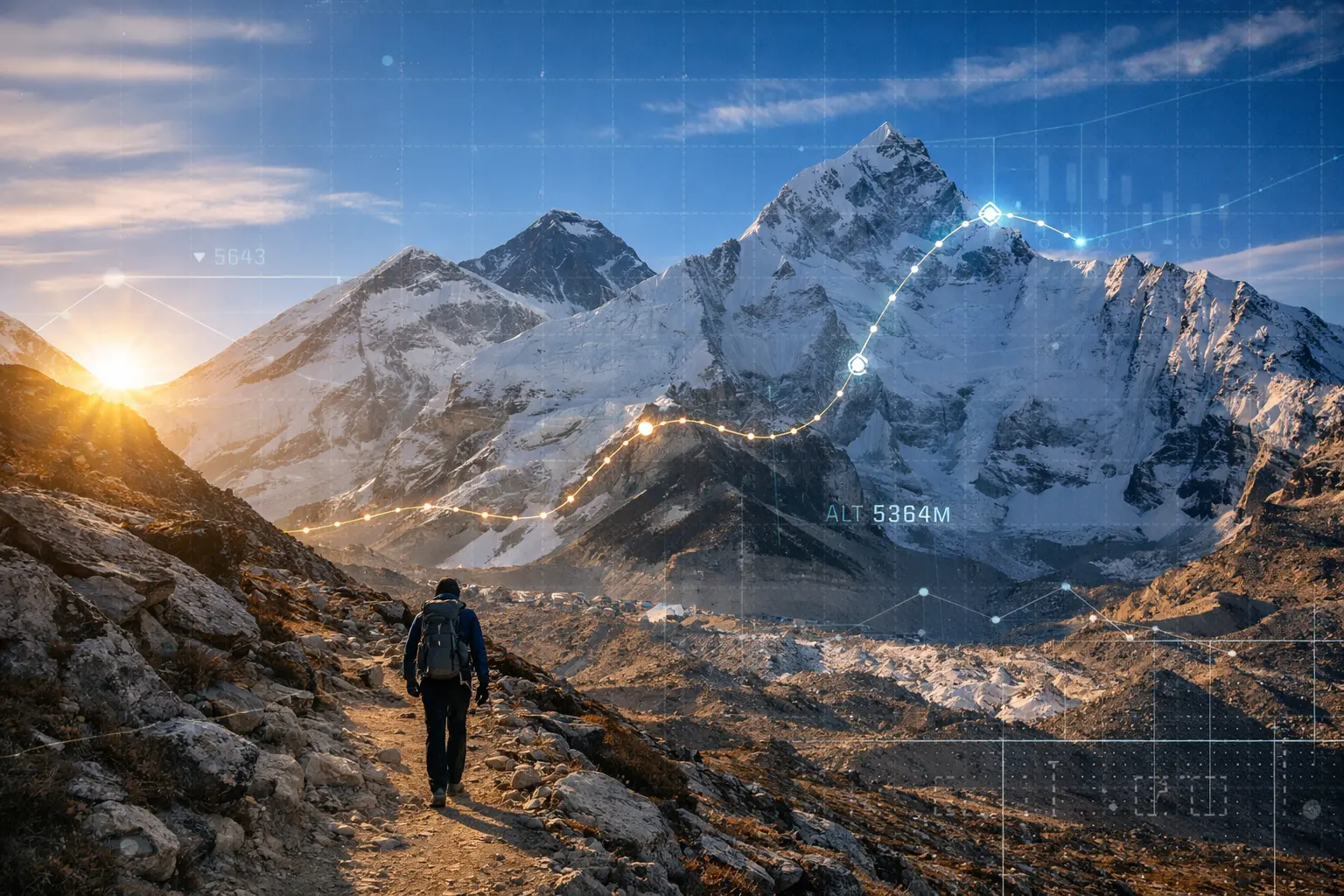
Using AI to Plan a Himalayan Trek: What Works and What Fails 🏔️🤖
The idea of using AI to plan a Himalayan trek is no longer theoretical. Increasingly, trekkers use tools such as ChatGPT to draft itineraries, estimate budgets, and structure their preparation.
However, while the promise of efficiency is appealing, the Himalayas remain unpredictable, high altitude environments where optimisation alone is insufficient.
This guide explores what genuinely works when using AI to plan a Himalayan trek, what does not, and how you can integrate it intelligently into real-world preparation.
For a complete overview of trekking in Nepal, read our Nepal Trekking Guide.
What Works When Using AI to Plan a Himalayan Trek
Structured Itineraries and Route Frameworks

AI typically includes acclimatisation days. It usually spaces elevation gains logically and references key stopovers such as Namche Bazaar, Manang and major landmarks along the route.
You can find a detailed breakdown in my Everest Base Camp trekking guide, where I explore daily pacing, altitude challenges, and recovery realities in far greater depth. Likewise, my Annapurna Circuit trek guide, examines the nuances of crossing Thorong La and managing gradual elevation gain, balancing structure with lived experience.
Budget Forecasting and Permit Clarity
Additionally, AI handles cost breakdowns efficiently.
AI can clearly summarise permit costs, domestic flights to Lukla, lodge pricing ranges, and porter fees. You can then cross-check this information against sources such as the Nepal Tourism Board for accuracy.
Nevertheless, real-time volatility is rarely captured fully. Aviation delays, weather disruptions, and currency fluctuations may alter costs rapidly.
Therefore, trekkers should treat AI as a baseline estimator rather than a final authority.
Where Using AI to Plan a Himalayan Trek Falls Short
AI Cannot Personalise Altitude Physiology

AI understands acclimatisation theory, but it does not understand personal physiological response.
Altitude sickness can develop unpredictably. Sleep disturbance, appetite reduction, and mild cognitive fog may emerge subtly before serious symptoms appear. Algorithms cannot model such nuance.
Accordingly, while using AI to plan a Himalayan trek may produce logical rest days, self-awareness remains essential.
For official medical guidance on recognising and managing altitude sickness symptoms, refer to the NHS altitude sickness page
Weather Uncertainty Remains Analogue
Furthermore, seasonal summaries are accurate in principle. AI typically identifies pre-monsoon and post-monsoon windows correctly.
However, static data cannot meaningfully forecast unseasonal snowfall, flight cancellations into Lukla, or heavy cloud cover at Kala Patthar.
Therefore, real-time judgement continues to outweigh predictive modelling.
Emotional Load Is Not Quantifiable
Distance and elevation are measurable. Fatigue accumulation and psychological strain are not.
When trekking above 4,500 metres, cognitive sharpness declines and decision-making becomes slower. Consequently, reliance solely on pre-planned structure may prove limiting.
In this context, trekkers should treat using AI to plan a Himalayan trek as preparation support rather than decision replacement.
A Smarter Way of Using AI to Plan a Himalayan Trek
Rather than rejecting technology entirely, trekkers can adopt a balanced framework.
Step 1: Generate Structure with AI
AI can create initial itinerary drafts, packing frameworks, and budget ranges efficiently.
Step 2: Cross-Reference with Human Sources
Trekkers should review recent trek reports, government advisories, and updates from local operators. Mapping platforms such as Google Maps can assist with terrain context.
Step 3: Overlay Personal Experience
Fitness level, prior altitude exposure, and risk tolerance must then shape the final version.
Thus, using AI to plan a Himalayan trek becomes an accelerant rather than a replacement.
Final Verdict: Efficiency Meets Experience
Ultimately, using AI to plan a Himalayan trek improves structural clarity. Research time is shortened. Information is consolidated. Preparation confidence increases.
Nevertheless, mountain travel remains inherently uncertain.
Therefore, technology should inform decisions, not override judgement.
In the Himalayas, optimisation must always be secondary to awareness.
Planning Everest Base Camp After Using AI
After using AI to plan a Himalayan trek, trekkers must still ground their preparation in detailed route knowledge and lived experience.
👉 Read the full Everest Base Camp trekking guide
👉 Explore the detailed Annapurna Circuit trek guide
If AI in travel planning interests you, I am developing deeper guides on AI tools, route building, and high-altitude decision making.
Join the newsletter to follow the full AI and Himalayan trekking series as it expands.
In the mountains, structure may be digital. Judgment must remain human.
Authority is built where technology and experience intersect.
Leave a Reply